Hoods · blowers · downdrafts
Repairing Wolf Range Hoods and Downdrafts
A struggling Wolf hood usually gets noticed somewhere other than the kitchen: in the hallway, on the bedroom curtains, on the cabinet doors above the range. We work out whether the hood is broken, outmatched or simply choked, then fix what is actually wrong. Call (949) 591-8171 or book a visit.
Grade 4.8/5 from 187 customer reviews How the grade was counted
- Book a visit
- (949) 591-8171day or night
- $89 per stop · visits 8–6 daily
Clues the rest of the house gives you
A hood's job ends where the cooking smell stops. When it quits doing that job, the evidence tends to turn up away from the range. Here are typical signs, paired with the fault that tends to be hiding behind them.
-
Last night's dinner still hangs in the living room the next morning
Likely culprit Air is moving too slowly: baffles caked in grease, a blower lagging below its set speed, or a damper stuck half closed
-
Smoke curls out past the hood lip whenever you sear on high
Likely culprit A capture problem: the fan never reaches top speed, or the hood is too narrow or mounted too high for the burners below. A burner with a lazy yellow flame adds soot of its own
Open the repair page -
A tacky film forms on the upper cabinets and the ceiling around the range
Likely culprit Grease escapes before it reaches the filters: weak draw, saturated filters, or a nearby window or air-conditioning return pulling the plume sideways
-
The fan hums but the blades never get going
Likely culprit A failing motor capacitor or seized motor bearings; on some models a relay or control fault that sends power without a proper start
-
A rattle, whistle or roar that wasn't there last month
Likely culprit A blower wheel that has loosened or collected debris, a flapping backdraft damper, or a section of duct that has slipped loose at a seam
-
Lights flicker, or one lamp quits even though the blower keeps spinning
Likely culprit A lamp or socket worn out by heat, a loose connector, or a fault in the lighting circuit on the control
-
The keypad stops responding, or the blower kicks on by itself
Likely culprit A worn button panel, a control board fault, or, on models with heat sensing, the sensor doing its job and calling for air
-
Cold air or street noise comes through the hood when it's off
Likely culprit The backdraft damper is stuck open or the exterior cap is damaged
Broken, outmatched or smothered
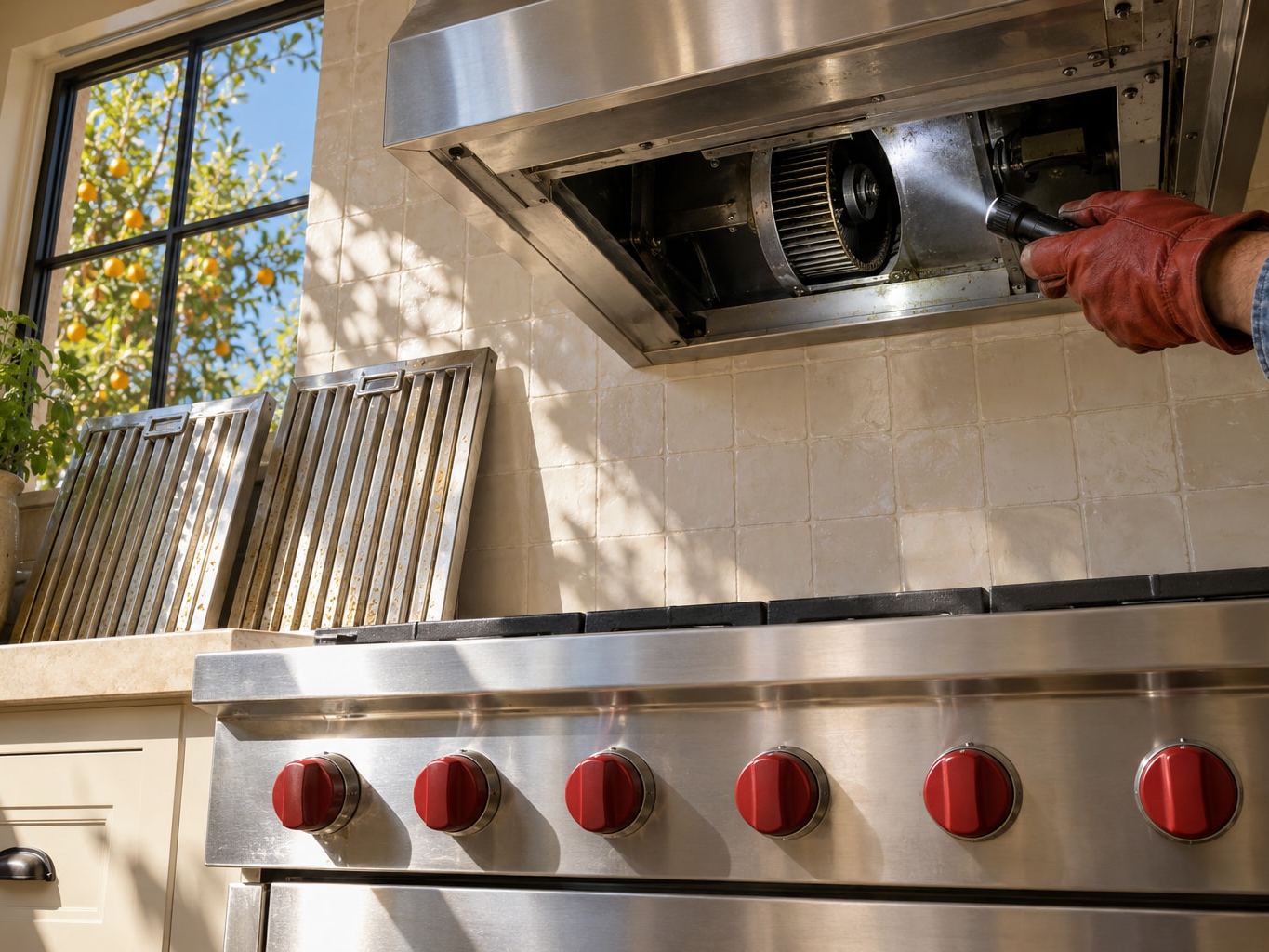
When a hood falls behind, there are three very different explanations, and only one of them is a repair in the usual sense. The first is a genuine fault: a motor running slow, a capacitor that has dried out, a switch or board that no longer passes power, a damper frozen in place. The second is capacity. A hood matched to a smaller range, or hung higher than the burners beneath it really allow, copes with weeknight cooking for ages and then loses the fight the first time someone sears on every burner at once. The third is the air path: filters loaded with grease, a duct with too many bends or a crushed section, an exterior cap plugged by nesting birds, leaves or crusted salt.
People usually call about the first and actually have the second or third, or a mix of all three. That is why we never begin by ordering a motor. We confirm what the blower does at each speed, what actually reaches the outside cap, and how the hood sits relative to the cooktop or range below it. If your hood turns out to be healthy but undersized for the way you cook, you hear that plainly, instead of paying for parts that were never at fault.
Wolf ventilation comes in several forms: wall and island chimney hoods, pro-style hoods, liners that disappear into custom cabinetry, and downdraft units that rise from behind a cooktop. Some carry the blower inside the hood; others mount it inline in the ductwork, or outside on a roof deck or wall. Where that blower sits decides where the noise comes from, where the work happens and how much of the kitchen we need to reach. If you're planning a remodel rather than a repair, our note on kitchen layouts for Wolf appliances is a useful place to start.
Who can fix a Wolf range hood in Orange County?
OC Wolf Appliance Service, an independent Orange County outfit, handles Wolf chimney, island, pro-style and liner hoods plus Wolf downdrafts, from Yorba Linda south to San Clemente. Getting a technician to the house costs $89; that single charge stays the same whatever else in the kitchen we open, and it comes off the bill. Ring (949) 591-8171 or pick a slot.
A hood at fault, or a hood that's outmatched?
From the stove the two feel identical. These details tell them apart.
Something inside the hood has failed
- It used to clear the kitchen and now doesn't, with the same cooking
- A speed is missing, or high sounds no different from low
- New noise: grinding, buzzing, rattling, or a hum with no spin
- Lamps, keypad or a filter-clean light (on models that have it) misbehave
- The change came suddenly, frequently right after a blackout or a marathon cooking day
The hood is undersized, smothered or badly ducted
- It has never truly kept up with every burner or the griddle going
- All speeds work and sound right, yet smoke still spills past the front edge
- The filters are heavy with grease or haven't been out in a long while
- Flow at the outside cap is weak even on high, or the duct runs long with several turns
- In a tightly sealed house the hood seems to pull against closed windows, a sign it may need make-up air
Packer's noteIf most of what you see lands on the left, it's a repair, priced after the inspection. If it lands on the right, the honest fix may be cleaning, a duct correction or a conversation about capacity, and you hear that before a dollar goes past the trip charge.
How a hood call runs, start to finish
-
Your description first
We ask what you're cooking when it struggles, how long it has been that way and what changed. A hood that gives up only under high heat points somewhere else entirely than one that won't run at any setting.
-
Filters out, housing open
The baffle filters come out so we can judge the grease load, then we inspect the blower housing and wheel for debris, imbalance and wear.
-
Speed by speed
Each fan speed is run and listened to. We test the motor, the capacitor, the switches or control board and the wiring between them.
-
Following the air outside
Where the duct run allows, we check the backdraft damper and the exterior cap, so we know the air is really leaving the house and not stalling halfway.
-
Numbers on the table
Once the fault is pinned down, you see what the fix will cost before anyone picks up a tool, and the $89 trip charge is subtracted from it. When a component needs ordering, we book a second stop to install it.
What stops a Wolf hood fan from running?
A Wolf hood fan that won't start usually has a power or control problem, such as a tripped breaker, a failed switch, button panel or control board, or a motor fault, most often a dead start capacitor or worn bearings. If it hums without spinning, stop using it: a stalled motor overheats. Each piece can be tested on one visit.
Salt on the coast, dust in the foothills
The same Wolf hood ages differently depending on which part of the county it breathes. The repair itself doesn't change from town to town, but where we look first does.
-
Beach towns, Huntington Beach to San Clemente
Damp, salty air works on the exterior cap, the damper hinge and any exposed duct fasteners. Grease on the filters picks up moisture and turns gummy sooner. A cap facing the ocean is worth checking whenever flow drops for no obvious reason.
-
Hillside and canyon homes
In Laguna Beach, Laguna Niguel and Aliso Viejo, longer duct runs through sloped rooflines and wind crossing the canyons can make a backdraft damper chatter or stick. Birds and blown leaves find any cap with a torn screen.
-
The inland foothills
Yorba Linda runs hotter and drier, and Santa Ana winds carry fine dust that coats blower wheels and caps. Gusts also slap a loose damper, so a tapping noise on windy nights is more often the damper than the motor.
-
Planned communities
In Irvine, Ladera Ranch, Mission Viejo and Tustin Ranch, association rules can cover exterior caps and roof work, so a cap or duct fix may need a word with your HOA first. Open floor plans there make a weak hood show up in the family room almost at once.
Hood repair, city by city
-
Town call
IrvineVillage homes, HOA roof rules, open kitchens.
-
Town call
Newport BeachHarbor air, island and bluff-top homes.
-
Town call
Laguna BeachCanyon wind, long duct runs, steep driveways.
-
Town call
Dana PointClifftop salt air on caps and dampers.
-
Town call
Huntington BeachMarine fog and remodeled beach kitchens.
-
Town call
Costa MesaMixed-age homes and recent remodels.
-
Town call
TustinFrom Old Town cottages to Tustin Ranch.
-
Town call
Yorba LindaFoothill heat and Santa Ana dust.
-
Town call
Mission ViejoKitchens from several building eras.
-
Town call
San ClementeOcean-view homes at the county's south end.
-
Town call
Laguna NiguelHilltop homes in the westerly sea breeze.
-
Town call
Aliso ViejoCanyon-edge houses and townhomes.
-
Town call
San Juan CapistranoHistoric streets and ranch properties.
-
Town call
Ladera RanchA planned community with HOA guidelines.
Why is my Wolf range hood so loud?
A Wolf hood that has suddenly turned loud usually has something loose or worn: a blower wheel that has shifted or gathered grease, failing motor bearings, a damper banging inside the duct, or a filter that isn't seated. A hood that has always been loud on high may simply be moving a lot of air, and an inspection tells the two apart.
What hood owners ask before they call
- Is it safe to keep cooking under a Wolf hood that grinds?
- We'd rather you didn't run it on high. Grinding usually means worn bearings or the blower wheel scraping its shroud, and running it longer can ruin the motor or the housing with it. Until it's checked, cook on lower heat and use the lowest speed that still runs quietly.
- How do I clean Wolf baffle filters?
- Lift them out by hand, then let them sit in a sink of very hot, soapy water with a grease-cutting detergent, or run them through the dishwasher if your manual says that is fine. Dry them fully before sliding them home. How often depends on your cooking: searing and frying load them far faster than steaming vegetables.
- Should a broken Wolf hood be fixed or swapped out?
- Motors, capacitors, switches, lights and dampers can all be replaced, and a Wolf hood is usually framed into cabinetry or a custom surround, so replacing it means more than swapping a box. After the inspection you get a firm repair figure, and the decision is yours.
- While you're here, could you check the Wolf range below the hood too?
- Gladly. $89 buys the trip, not one appliance, so a hood plus a range or a steam oven all fit inside a single stop. Every fix gets its own figure once inspected; the pricing page lays out the logic.
Hood falling behind? Let's find out why
Someone picks up the phone 24/7; technicians are out 8 AM to 6 PM daily. A single $89 trip charge covers every Wolf piece we look at that day and is deducted once you approve the repair.
House-call fee: $89, never multiplied by how many Wolf pieces are on the list; approve the fix and the $89 gets credited against its total.