Wolf ranges · Orange County
Wolf range repair that starts with your notes
Before a Wolf range quits, it usually drops hints: a burner that needs extra clicks, a flame gone soft and orange-tipped, an oven that wanders off its setting. Note those hints down and the visit heads straight for the failing system, whether your range is all gas, marries gas burners to an electric oven, or cooks by induction.
Grade 4.8/5 from 187 customer reviews How the grade was counted
- Book a visit
- (949) 591-8171day or night
- $89 per stop · visits 8–6 daily
What every range visit runs on, before any diagnosis:
-
Per house call
$89 a stop
One $89 per house call, and it stays one $89 if the technician inspects a lone wall oven or a whole row of Wolf gear from cooktop to backyard grill; approve the fix and the $89 gets credited against its total.
-
Repair price
Named after diagnosis
You hear the repair price in person, after diagnosis pins down the fault; parts get ordered only once you approve that price.
-
Phone answered
Day and night
Ring at midnight, on a Sunday or on a holiday morning and someone at our desk still answers.
-
Technician hours
8 AM to 6 PM daily
House calls start at 8 AM and wrap by 6 PM, Monday straight through Sunday.
-
Cities covered
14 in Orange County
Aliso Viejo · Costa Mesa · Dana Point · Huntington Beach · Irvine · Ladera Ranch · Laguna Beach · Laguna Niguel · Mission Viejo · Newport Beach · San Clemente · San Juan Capistrano · Tustin and Yorba Linda.
Why a range log shortens the repair
A Wolf range problem often gets described as “it’s acting up.” That is honest, but it gives a technician very little to work with. A range is several machines sharing one chassis: sealed gas burners with their own spark system, an oven that may be gas or electric, a control layer, and on induction models a set of coils driven by power electronics. Each of those fails in its own way, and each leaves its own fingerprints.
So we ask owners to keep a short log for a day or two before the visit, or simply to think back carefully when they call. Which burner? Front left, rear right, the center griddle or grill if your model has one. Does it fail cold, or only after the cooktop has been running a while? Is the click steady, or does it stop once the flame catches? What color is the flame, and does it sit evenly around the cap or lift away from it? Does the display show anything, and does the oven reach the set temperature and then wander?
Those answers narrow the search before anyone opens a panel. A note like “rear left clicks for a long time after mopping the cooktop” points somewhere very different from “all burners spark at once and won’t stop.” The first is usually moisture or a cap that is not seated; the second tends to live in the spark module or a switch. When the log is clear, the technician walks in with a plan instead of a guess, and you spend less of your day with the range pulled apart.
The log never replaces testing — it aims it. Whatever you jot down, the technician still puts a meter on the suspect part before naming a fix. And if the hood above the range or a built-in wall oven has been sulking too, add it to the list: looking at three appliances costs the same trip charge as looking at one.
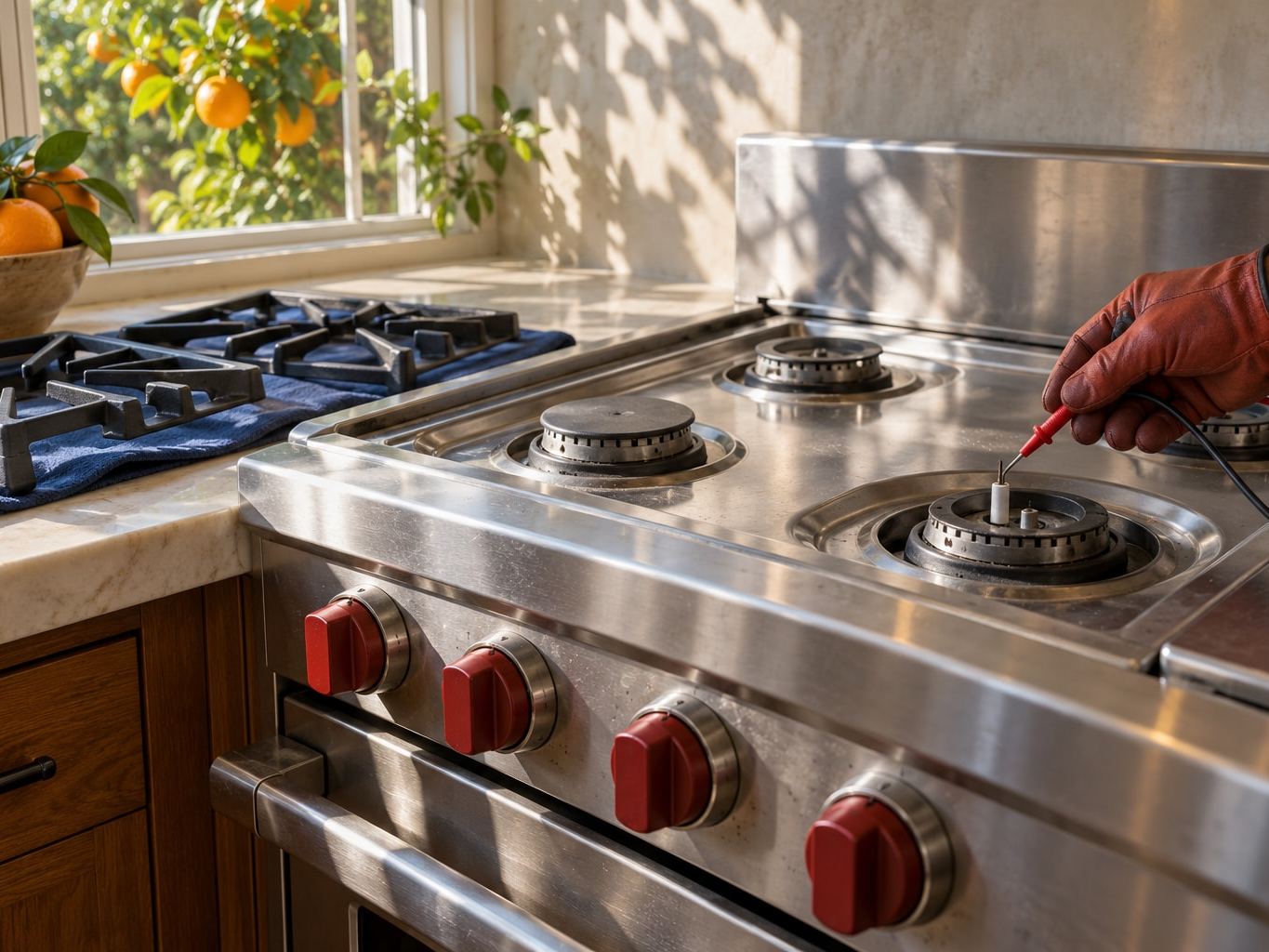
Gas, dual fuel, induction: signs by fuel type
The same complaint can mean different things depending on how your range makes heat. Find your fuel type, then the line that matches your notes.
-
Gas or dual fuel: one burner clicks and clicks but never lights
Likely culprit An igniter soaked during cleaning or hairline-cracked, a cap knocked askew on its base, or burner ports gummed up after a boil-over
-
Gas or dual fuel: sparking carries on after the burner has caught
Likely culprit Moisture or grease inside one of the spark switches, or a reignition circuit misreading the flame
-
Gas or dual fuel: flame is yellow, ragged or lifts off the burner
Likely culprit Ports half-blocked with residue, a cap sitting crooked, or a supply-side pressure issue that has to be measured
-
All-gas range: cooktop works, but the oven never comes up to heat
Likely culprit Most often the oven igniter has weakened — it still glows, yet can’t pull the gas valve open; less often the valve or control itself
Open the repair page -
Dual fuel: burners are fine, the electric oven is cold or slow
Likely culprit An element with a burned-out spot, a control-board relay that won’t close, or the oven sensor
Open the repair page -
Dual fuel or induction: oven overshoots, then sags below the setting
Likely culprit The oven sensor reading off, a convection fan that has stopped stirring the air, or heat escaping past a tired door gasket
-
Induction: a zone beeps and stays cold with a pot on it
Likely culprit Cookware that is not magnetic or is too small for the zone; if a known-good pan fails too, a coil or power board
-
Induction: zones cut out partway through a long simmer
Likely culprit Thermal protection kicking in because the internal cooling fan has slowed or dust is choking its airflow
-
Any range: display dark, knobs or touch controls do nothing
Likely culprit Check the breaker and supply first; after that, the control board or the supply feeding it
Why is my Wolf range clicking?
Nonstop clicking means the spark system believes a burner still needs a light. Most often a burner switch has taken on water or spray cleaner during wiping, a cap has been bumped off-center, or the spark module itself has given out. If a night of drying changes nothing, the switch or module needs testing.
From your note to the system we test
Here is the way a technician reads your notes. Treat it as a map for the inspection rather than a phone diagnosis.
What the owner wrote down, and where the visit starts
| Your note says | System it points to | What gets checked first |
|---|---|---|
| One burner, only after cleaning | Spark ignition at that burner | Igniter, cap seating, switch for trapped moisture |
| Every burner sparks together, nonstop | Shared spark circuit | Spark module and each burner switch in turn |
| Flame low on every burner at once | Gas supply to the range | Supply pressure, regulator, shutoff fully open |
| Oven slow to heat, cooktop normal | Oven heat source | Igniter draw on gas ovens, elements on electric ovens |
| Oven reaches temperature, food still uneven | Heat distribution | Convection fan, sensor reading, door seal |
| Induction zone errors with every pan | Power electronics | Coil, generator board, cooling airflow |
| Controls freeze or reset by themselves | Control layer | Supply voltage, connections, control board |
Why is my Wolf range oven not heating?
With an all-gas range, look first at the oven igniter: as it ages it keeps glowing yet stops drawing the current that opens the gas valve. Dual-fuel and induction ranges have electric ovens instead, where a burned element, a sticking relay or a bad sensor is the likelier culprit. A meter on the parts settles it.
Jot these down before you dial
A minute with a notepad or your phone camera saves time on the visit.
- Fuel setup: gas top and gas oven, gas top over an electric oven, or induction
- Which burner, zone or oven cavity misbehaves, and whether it is always the same one
- When it happens: cold start, after a long cook, after cleaning, or at random
- Sounds: a constant tick, one click and then silence, a hum, a whirring fan, or no sound at all
- What the flame looks like: blue and even, yellow, lifting, or uneven around the cap
- Any message, flashing light or code on the display — a photo is ideal
- Model and serial from the rating plate — usually tucked behind the lower kick panel or on the oven door frame
Gas in the air? Read this first
Range repair in your part of the county
Each city page covers how ranges are installed and used there — open yours for the local details.
-
Town call
IrvineVillage kitchens, island ranges and HOA-built homes across the planned city.
-
Town call
Newport BeachHarbor and hillside homes where salt air reaches the kitchen.
-
Town call
Laguna BeachCanyon and cliffside houses with steep, narrow approaches.
-
Town call
Dana PointHarbor-side kitchens that live with ocean moisture all year.
-
Town call
Huntington BeachBusy family kitchens near the coast and around the harbour.
-
Town call
Costa MesaRemodeled kitchens in established neighborhoods between the 405 and the coast.
-
Town call
TustinFrom Old Town houses to newer builds on the former base land.
-
Town call
Yorba LindaFoothill homes on large lots, hotter and drier than the coast.
-
Town call
Mission ViejoHomes from several building eras, so ranges of many generations.
-
Town call
San ClementeThe county’s southern edge, where coastal air meets tile-roofed homes.
-
Town call
Laguna NiguelHilltop neighborhoods and gated enclaves looking toward the ocean.
-
Town call
Aliso ViejoTownhomes and canyon-edge houses near the wilderness park.
-
Town call
San Juan CapistranoHistoric streets, ranch properties and homes of every age.
-
Town call
Ladera RanchOpen-plan family kitchens in a planned community off the 241.
Who repairs Wolf ranges in Orange County?
OC Wolf Appliance Service does: an independent outfit whose everyday work is Wolf cooking gear — gas, dual-fuel and induction ranges, plus the ovens, cooktops and hoods around them — in homes from Yorba Linda to San Clemente. A person answers (949) 591-8171 around the clock, and the $89 trip charge is deducted once you approve a repair.
Range questions owners ask us
- Is a Wolf range that’s been in the kitchen a long time still worth repairing?
- Usually. Igniters, spark switches, elements, sensors and valves wear; the cooktop, oven box and frame rarely do. Whether yours deserves the repair comes down to what broke and whether that part is still obtainable for the model — two things the inspection pins down. You’ll hear the figure before a screw turns, and whether to proceed is entirely your call.
- Will the technician also look at my hood or wall oven while they’re here?
- Gladly. The trip charge doesn’t multiply with the number of appliances, so range, ventilation hood and built-in oven can be checked together. Each one is priced on its own after testing, and you approve them one by one.
- How should I clean the burners so the clicking doesn’t start?
- Let the top cool, then lift grates and caps and wipe with a cloth wrung almost dry rather than spraying the surface. Dry caps and burner bases fully and drop each cap back so it lies flat and centered, without a wobble. Pooled water and spray cleaner are the usual reasons a spark switch starts ticking by itself. Our post on early warning signs lists other quirks worth catching before they become a breakdown.
- What will the range repair cost?
- Ask us for a number over the phone and you’ll get only one: the $89 trip charge, credited back when the range is fixed. Past that, the figure rides on the failed part and how far inside the range it is buried, so it is set at your kitchen counter after testing, and no wrench turns until you say go. How we price lays out what nudges that figure.
Have your range notes ready?
Phone us whenever the range acts up — the line never closes — or pick a visit slot online. Share the fuel setup and your notes, and the technician shows up already knowing which system to open first.
House-call fee: $89, never multiplied by how many Wolf pieces are on the list; approve the fix and the $89 gets credited against its total.