Wolf wall ovens · Orange County
Wolf oven repair for temperatures you can’t trust
Most built-in oven complaints come down to one thing: the dial says one number, the food says another. Here is how to check which is lying, what a steady offset means compared with a wild swing, and when a part — not a recipe — is to blame.
Grade 4.8/5 from 187 customer reviews How the grade was counted
- Book a visit
- (949) 591-8171day or night
- $89 per stop · visits 8–6 daily
Is the oven telling the truth about its heat?
Start with what dinner looked like. The left column is what owners notice; the right is what usually sits underneath it on a Wolf wall oven.
-
Cookies scorch at the edges and stay doughy inside at your usual setting
Likely culprit The cavity is running hotter than displayed, or the convection fan has quit spreading heat and the element side is overheating
-
Roasts drag on well past the recipe even though the display looks right
Likely culprit The oven is running cool: a sensor reading high, or a bake element that has weakened with age
-
The ready tone plays, but a thermometer shows the cavity well short of the set point
Likely culprit Sometimes normal settling after the tone; if it never catches up, a sensor or heating circuit fault
-
Display and light work, yet nothing warms up
Likely culprit A failed element, a relay that never closes on the control board, or a door-lock switch telling the oven the door is open
-
Screen completely dark, no beep, no light
Likely culprit A tripped breaker or loose connection first; then the power supply or the control board itself
-
Grinding, rattling or silence where the convection fan should whir
Likely culprit Worn fan motor bearings, a loose blade, or a motor that has stopped
-
Door stays locked long after a self-clean cycle has cooled
Likely culprit A lock motor or lock switch that did not report the door released, if your model has self-clean
-
Heat or moisture escaping onto the controls and cabinet faces
Likely culprit A door gasket squashed flat, or hinges that have lost the tension to seal the door
-
Broil barely browns the top of anything
Likely culprit A broil element with a dead section, or a fault in the circuit that powers it
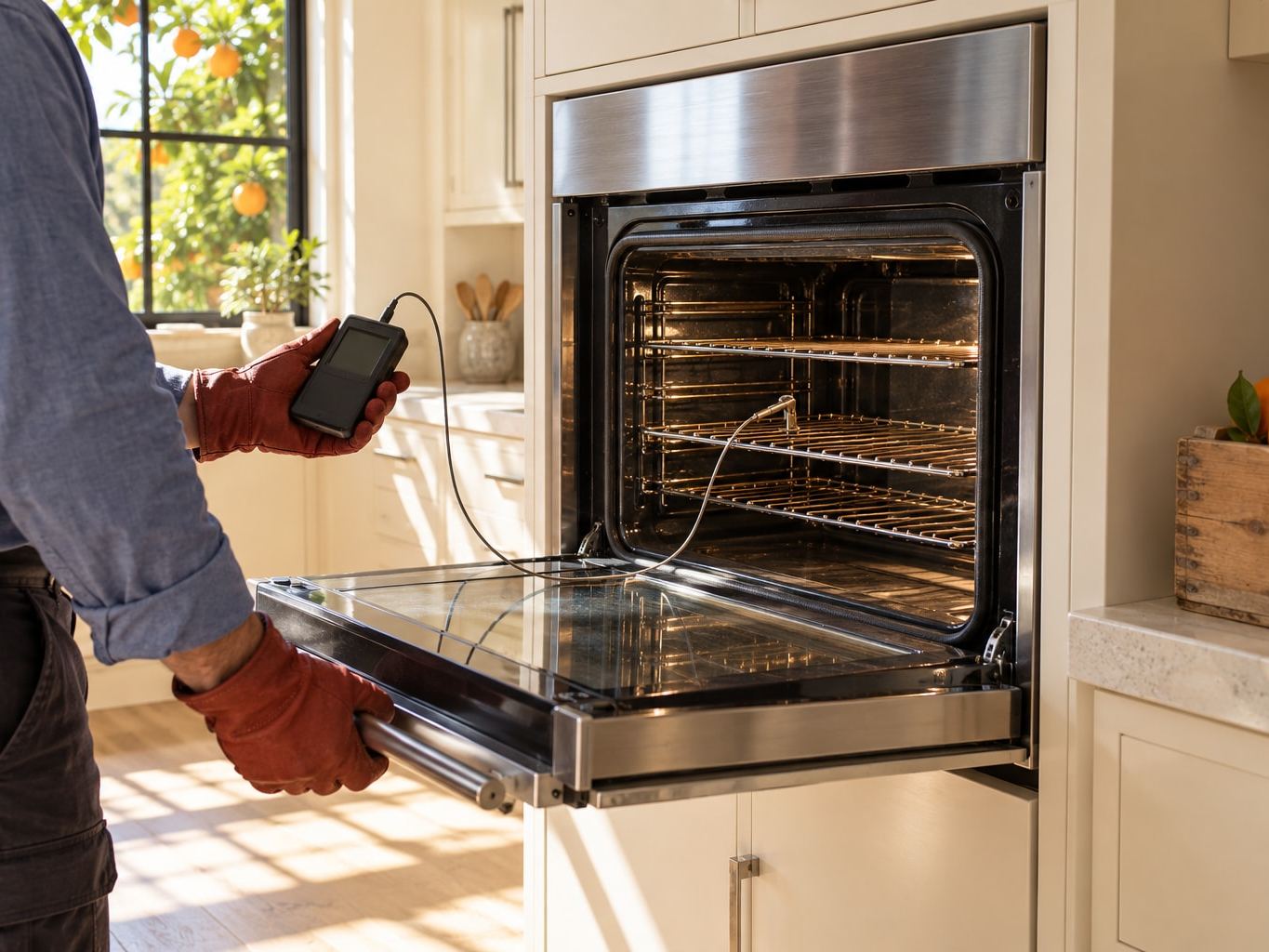
Why won’t my Wolf oven heat to the set temperature?
Either a heat source is weak or the oven is measuring wrong. A tired bake element, a stalled convection fan or a leaky door seal keeps the cavity short; a drifting temperature sensor makes the control believe it has already arrived. A thermometer check over several heating cycles tells which.
Measure first, then decide what is broken
An oven never holds one exact temperature. It heats past the set point, coasts, cools a little and heats again, so the air inside swings around your number all the time. That is normal. What matters is where the middle of that swing sits, and whether it stays put from a Monday bake to a Friday one.
This is why a single glance at a thermometer misleads people. Open the door, read it once, and you might catch the top of a cycle or the bottom of one — or a reading pulled down by the cold air you just let in. Owners then call in a part failure that is really an oven doing its job. The opposite happens too: a slow sensor drift creeping upward over a season gets blamed on new flour or a different pan.
A careful check takes patience rather than tools. One decent oven thermometer, an evening at home, and the steps below will tell you whether you have a steady offset — the oven is always a bit hot or a bit cool — or something that is genuinely failing to heat, holding, or measuring.
Do this in standard bake mode, not convection, with the racks you normally use.
-
Place the thermometer
Set an oven-safe thermometer at the center of the middle rack, readable through the door glass so the door stays closed.
-
Pick a middle setting
Choose a moderate baking temperature in plain bake, the mode you trust most for everyday cooking.
-
Ignore the tone
Let the oven keep going long after the preheat tone so walls and racks finish soaking up heat.
-
Read it several times
Note the thermometer at intervals through the window. Write down the highest and lowest readings you see over a few cycles.
-
Find the middle
Average the high and low. That middle is what your oven actually bakes at, compared with what you set.
-
Read the result
A steady difference in the same direction points to calibration. Big swings, no heat at all, or a difference that changes every time points to a part — that is a service call.
How do I recalibrate a Wolf oven?
Plenty of Wolf wall ovens offer an owner-adjustable temperature offset inside the settings; the use-and-care guide for your model shows the path. Adjust only after a careful thermometer check across several cycles. If the error is large, keeps changing, or comes with uneven baking, recalibrating hides a failing sensor or element instead of fixing it.
Which oven system the symptom points to
Four systems share a Wolf wall oven cavity. Each failure tends to show up in its own way, which is what the technician uses to decide where to test first.
Symptom and the oven system most often behind it
| What you notice | System | Why it points there |
|---|---|---|
| Thermometer agrees with itself but not with the display | Sensor | A steady offset means heat is produced fine and measured wrong |
| Slow preheat, pale results, the same in every mode | Heating | An element or its relay is no longer delivering full output |
| Fine in bake, uneven or slow only in convection | Fan | The convection fan or its own element is not doing its part |
| Hot one side, cool the other, front-to-back browning | Fan or door | Air is stagnant, or heat slips out past the gasket |
| Settings ignored, random beeps, resets mid-cook | Controls | The board, its supply, or a loose harness connection |
| Oven refuses to start with the door shut | Controls | Door switch or lock reporting the wrong position |
| Normal one day, cold the next, no pattern | Heating or controls | An intermittent relay or connection that only a live test catches |
Oven visits across Orange County
Pick your city for notes on the kitchens and homes we drive to there.
-
Town call
IrvineDouble wall ovens in village homes from Woodbridge to Turtle Rock.
-
Town call
Newport BeachEntertaining kitchens where an oven fault shows up right before guests.
-
Town call
Laguna BeachTight hillside kitchens with ovens built into custom cabinetry.
-
Town call
Dana PointOvens in homes above the harbor and along the bluffs.
-
Town call
Huntington BeachEveryday family baking, from Huntington Harbour to inland tracts.
-
Town call
Costa MesaWall ovens added during remodels of older Mesa Verde and Eastside homes.
-
Town call
TustinTustin Ranch and Tustin Legacy kitchens with stacked oven columns.
-
Town call
Yorba LindaBig inland kitchens that run hot summers alongside a hot oven.
-
Town call
Mission ViejoOvens of many vintages around the lake and Saddleback neighborhoods.
-
Town call
San ClementeTile-roofed, white-walled homes from Talega to Forster Ranch.
-
Town call
Laguna NiguelView homes on the hills with ovens set into large islands and walls.
-
Town call
Aliso ViejoCompact townhome kitchens where the oven sits close to everything.
-
Town call
San Juan CapistranoHouses old and new, near the Mission and out on ranch land.
-
Town call
Ladera RanchBusy family ovens in a planned community governed by HOAs.
Two beliefs that cost people dinners
-
Heard at the fruit stand
The oven beeped, so it is at temperature.What the kitchen showsThe tone only marks the first time the sensor hit the set point. Racks, walls and stone are still absorbing heat, and the first cycles can swing well around your number.
-
Heard at the fruit stand
An oven that runs hot is worn out and needs replacing.What the kitchen showsA steady offset is often just an adjustment, and sensors and elements are swappable parts. The cavity, door and frame of a Wolf wall oven usually have plenty of life left.
Who does Wolf oven repair in Orange County?
OC Wolf Appliance Service: an independent crew whose core work is Wolf cooking equipment, single and double wall ovens included, covering Orange County from Yorba Linda south to San Clemente. Phones are answered 24/7, and the $89 trip charge is credited toward whatever repair you approve.
What oven owners ask before booking
- Should I run a self-clean cycle before the technician comes?
- Better not. Self-clean drives the cavity to its hottest, a hard ask for a part that is already on its way out, and a misbehaving lock can keep the door shut for the whole visit. Brush out loose crumbs and leave the rest; grime doesn’t get in the way of a diagnosis.
- Will the technician need to pull my wall oven out?
- Often not: plenty of fixes happen through the open door or behind a removable panel. Certain faults do require easing the oven forward on its runners to get at the wiring behind it, and that is done with care for the surrounding cabinets. Leaving the counter below the oven bare gives the technician space.
- Only the top cavity of my double oven is acting up — is that normal?
- Very. The two cavities of a double wall oven heat with separate elements and read separate sensors, so the upper one can quit while the lower bakes fine. A few parts may serve both — the control board, for one — so the technician tests both cavities while there.
- How do I know whether it’s my oven or my recipe?
- Run the thermometer check above. If the middle of the swing sits close to your setting and stays there, the oven is fine and the recipe, pan or rack position is the variable. If the middle is far off, or it changes from day to day, the oven needs service.
- What does an oven visit cost?
- The trip runs $89 and is subtracted from the repair once you approve one. What the repair itself comes to depends on the failed part and how your installation lets us get at it, so the number is given face to face after testing, and no part goes in without your go-ahead. See what shapes a repair price; a range or hood can be looked at during the same stop.
- The refrigerator next to my oven stopped cooling — do you handle that too?
- Wolf covers the cooking half of the kitchen; refrigerators, freezers and wine units carry the Sub-Zero name, from the same parent company. Our article on a fridge that stopped getting cold untangles the two brands and lists what to check, and the Sub-Zero page picks it up from there.
Thermometer numbers in hand?
Tell us what you set, what you measured and what the food did. With those three facts the technician knows which oven system gets tested first.
House-call fee: $89, never multiplied by how many Wolf pieces are on the list; approve the fix and the $89 gets credited against its total.